


Siemens, Beckhoff, Fanuc, IO-Link – every machine speaks a different language. EdgeBrain is equipped with a full TCP/IP stack: TCP/IP-based protocols such as OPC UA and MQTT run directly on it. For fieldbuses, EdgeBrain communicates with loggers and gateways from every manufacturer – and consolidates all data streams on site.
Babel in the factory: How EdgeBrain brings together machines from different manufacturers
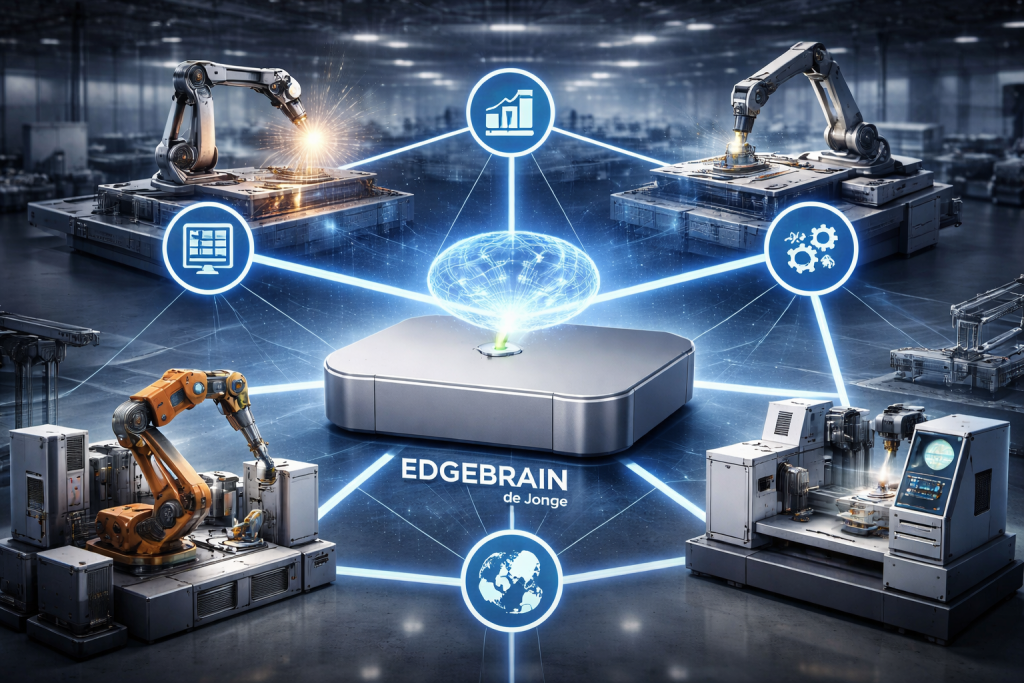
Siemens controller in line 1, Beckhoff in line 3, Fanuc robots in the welding cell, IO-Link sensors on the conveyor belt, a fieldbus system from the early 2000s and, in the middle of it all, the question: How do these worlds come together? The answer does not lie in the cloud or in a years-long IT project. It lies directly on the store floor.
The problem is not “lack of data”, it is “incompatible infrastructure”
Modern production environments have evolved over time. Investment decisions have been made over decades, always based on the best available technology for a specific task. The result is machinery that works but lives in silos.
On the one hand, there are modern systems: they communicate via TCP/IP-based protocols such as OPC UA or MQTT, are network-compatible and provide data that could, in principle, be used immediately. On the other hand, there are older or specialized systems: they speak fieldbuses such as PROFINET, EtherNet/IP, Modbus RTU, PROFIBUS, use IO-Link or proprietary interfaces that no standard network system understands out of the box.
Both worlds generate valuable data. But they have hardly ever communicated together.
What EdgeBrain brings to the table and what it enables
EdgeBrain is equipped with ix-Ethernet: an industrial Ethernet connection with a full TCP/IP stack. This means that all TCP/IP-based communication protocols (OPC UA, MQTT, REST, Modbus/TCP and others) can be implemented directly on EdgeBrain. Anyone who wants to connect a modern controller or a network-compatible sensor can do so without additional hardware, without detours and without loss of latency.
For fieldbuses and older systems, the architecture provides for a pragmatic step: Fieldbus loggers, IO-Link masters or protocol gateways are used as a dedicated hardware bridge. These devices speak the respective “machine language” and pass on their data via a network interface.
This is exactly where EdgeBrain comes in: It communicates directly with these loggers, IO-Link masters and gateways and brings together all incoming data streams locally. Locally. In real time. Without the data having to leave the factory.
The strength: consolidation directly on the store floor
What distinguishes EdgeBrain from traditional integration approaches is where the merging takes place.
In conventional architectures, data from various sources is uploaded to a central platform, often in the cloud or data center, where it is standardized and then uploaded back again. This means: latency due to data transport, dependence on network availability and external infrastructure costs.
EdgeBrain turns this principle on its head.
The fieldbus logger supplies its values. The IO-Link master passes on sensor status and process variables. The TCP/IP-capable controller sends its operating data directly. EdgeBrain receives all these streams, standardizes them to a uniform data model and makes the result available as curated gold data for MES, ERP, quality assurance or analytics. Everything happens locally, deterministically, in real time.
The result: a coherent data image of the entire machine fleet, regardless of how many manufacturers, protocols and generations it comprises.
Three scenarios from practice
Scenario 1: Cross-line OEE without data delay
Three production lines, three different controller generations. Line 1 communicates directly with EdgeBrain via OPC UA. Line 2 has a fieldbus logger that is connected via Modbus/TCP. Line 3 uses IO-Link masters for its sensors. EdgeBrain collects the data from all three sources, normalizes it to a common time grid and calculates OEE key figures in real time. No data export, no 24-hour delay, no central server.
Scenario 2: Quality correlation across system boundaries
A deviation in the end product occurs sporadically, but cannot be assigned to an individual machine. Thanks to EdgeBrain’s consolidated database, fed by temperature sensors via IO-Link, control parameters via OPC UA and pressure curves via fieldbus loggers, overarching correlations can be established. The cause: a temperature peak in an upstream process step that no system had previously seen on its own.
Scenario 3: Legacy integration without standstill
A CNC machine built in 2003 has no network interface, but outputs digital and analog status signals. A compact fieldbus logger reads these signals and makes them available via a TCP/IP interface. EdgeBrain integrates the logger and integrates the machine into the company-wide database without interfering with the control system, without stopping production and without new software on the machine.
Heterogeneity is not a weakness – if the consolidation is right
A mixed machine park is not a mistake. It is the result of sensible investment decisions. The challenge so far has not been the hardware itself – but the lack of a layer that operates above the manufacturer boundaries and transfers the existing diversity into a coherent data image.
With EdgeBrain, this layer is in place: network-capable for all TCP/IP protocols, open to loggers and gateways from any manufacturer, and able to consolidate all incoming data on site – before it leaves the factory or reaches a central platform.
That makes the difference: not another cloud solution that merges data retrospectively, but an edge instance that combines data where it is created.
How is your machinery set up? Talk to us about the right architecture for your environment: info@dejonge.ai

